

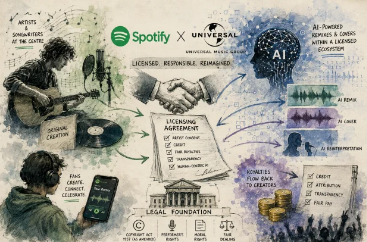
Spotify and Universal Music Group have signed a new licensing deal. The “landmark” agreement has introduced a paid add-on tool that will allow fans to generate AI-powered covers, remixes and reinterpretations of licensed tracks by participating artists.[i]
From what’s been reported so far:
This deal is only described as forthcoming. Nonetheless, the deal is described as exclusive to Spotify’s ecosystem. The Universal Music Group is covering both its recorded music and publishing arms. But the interesting thing is that it enables AI generated covers and remixes of songs from participating UMG artists and songwriters.
However, several questions remain unanswered, such as financial terms, contract length and how the royalty will be technically attributed and distributed, all of which highlight ambiguities in the deal’s actual implementation.[iii]
According to the Swedish streaming giants, this not only opens up additional revenue streams but also brings a new tool as an “additional source of income for artists and songwriters, on top of what they already earn on Spotify”.[iv]
AI remixing has become a strategically popular focus across the music industry. Startups like Udio, Hook have been building similar concepts.[v] The key distinction is that remixing existing licensed tracks is framed as a ‘fan engagement’ product, deepening the relationship between fan and artist, whereas AI-generated songs from scratch create direct market competition with artists. The music industry is far more comfortable with the former.[vi]
However, I feel that instead of trying to block AI music tools, labels and platforms seem to be building their own version of them inside streaming apps, and where especially people use tools like Suno into a setup that can create whatever they want?
Warner Music Group settled its copyright lawsuit against AI music startup Udio in November 2025 and simultaneously signed a licensing deal for a new AI music creation platform.[vii] Days later, WMG struck a similar agreement with Suno (the most popular AI music generator, with 100M+ users and a $2.45B valuation) and now has licensing agreements with the very AI platforms they were suing just one year ago.[viii] Not all major labels have followed this settlement path. Sony Music Group has not resolved any of its AI lawsuits involving Suno or Udio, and licensing talks between Suno and Universal Music Group have been deadlocked over distribution rights, with UMG wanting to limit AI song sharing to the app and Suno demanding it be made available on the internet. At the early stage of 2026, two out of the three main labels are still not settled.[ix]
In November 2025, all three major labels signed licensing deals simultaneously with AI music startup KLAY Vision.[x] Klay is building what it calls a ‘Large Music Model’ analogous to a Large Language Model but trained entirely on licensed music. The deal is notable because:
Not only this, but even SAG-AFTRA (the union representing actors and media professionals) reached a deal with all four major record label groups (Warner, Sony, Universal, and Disney Music Group) that includes AI protections. Under the agreement, the terms ‘artist’, ‘singer’, and ‘royalty artist’ explicitly refer only to humans. The deal runs until the end of 2026.[xi] This matters because it creates a union-negotiated floor of protections that applies to performing artists regardless of what individual label contracts say.
The Copyright Act, 1957, with Copyright Amendment 2012, is the primary statute governing all music rights in India.
Sound Recording vs. Underlying Works
Like the US framework, Indian copyright law distinguishes between two separate protected assets:
An AI-generated cover or remix in India would therefore potentially infringe three separate copyrights – sound recording, musical work, and literary work (lyrics) and each owned by different parties. A single licensing deal would need to address all three, as the Spotify/UMG deal does in the US context.
Performer’s Rights (Section 38 & 38A)
The 2012 amendment introduced a critical protection for performing artists, singers, musicians, and session artists.[xiii]
Section 38A:
Performers have a right of exclusive performance to their performances as embodied in sound recordings, meaning that no reproductions, broadcasts or communications to the public are allowed without the performer’s prior written consent. Once a performer has consented to a commercial sound recording, the producer can exploit that recording commercially.
Section 38B:
The performer retains moral rights, including the right not to have their performance subjected to distortion, mutilation, or modification that would be prejudicial to their honour or reputation.
An AI tool that generates a ‘cover in the voice of’ a specific artist, without that artist’s consent, it is a question of whether it would be liable to violate on their performer’s rights under Section 38B, regardless of whether the label owns the copyright.
The ‘Fair Dealing’ Limitation
India does not have a fair use doctrine. Instead, Section 52 of the Copyright Act, 1957, provides a narrower ‘fair dealing’ defence, which permits use without a licence only for:
Critically, AI training on copyrighted music is almost certainly NOT covered by fair dealing under Indian law, though this question awaits definitive judicial resolution. The private use carveout under Section 52(1)(a) requires reproduction by an individual for their own non-commercial purpose; systematic training of a commercial AI model on copyrighted works would not qualify. In the first Indian case to directly address the issue of whether the use of copyrighted material for AI training constitutes an exception to copyright, the Delhi High Court is currently testing this position in the case of ANI Media Pvt. Ltd. v. Open AI OpCO LLC.[1] In November 2024, the court admitted the suit and issued notice to OpenAI, failing to dismiss the claim at the threshold, which alone indicates that such training activity is not clearly a lawful use under existing Indian law. It is too early to consider fair dealing as a final safe harbour for AI training in India. This may be more stringent than the US stance, where the fair use discussion is alive and well, and courts are still grappling with a four-factor balancing test in the context of AI training.
Safe Harbour and AI Liability
Section 79 of the IT Act provides a conditional safe harbour to ‘intermediaries’ broadly, platforms that host or transmit user-generated content, provided they do not initiate the transmission, select the receiver, or select/modify the content. An AI music platform that generates covers using its own model is not acting as an intermediary in the traditional sense; it is generating content. This means it cannot rely on Section 79 safe harbour for AI-generated output, unlike a platform that simply hosts user uploads.
The 2021 Rules further require significant social media intermediaries (those with over 5 million users) to appoint grievance officers,[2] enable takedown mechanisms, and trace the originator of content on government request. A large-scale AI music platform would likely qualify as a significant social media intermediary.
India’s Proposed Digital India Act (Incoming Framework)
The Ministry of Electronics and Information Technology (MeitY) has been developing a Digital India Act (DIA) intended to replace the IT Act, 2000. While not enacted as of May 2026, the proposed DIA and associated AI governance consultations are relevant because:
Additionally, the NITI Aayog and MeitY have both released AI principles documents, both of which broadly support the responsible development of AI, but these are non-binding policy documents. The Department for Promotion of Industry and Internal Trade (DPIIT) has also put forth a proposal to implement a blanket licensing system for the use of copyrighted content in AI, providing a more tangible legislative signal.[4] In India, if adopted, it could drastically reshape the liability framework for AI training and could eventually offer a statutory foundation for such agreements as the Spotify x UMG deal in India.
[1] ANI Media Pvt. Ltd. v. Open AI Inc. & Anr., CS(COMM) 1028/2024, High Court of Delhi (Notice issued November 2024, matter ongoing).
[2] Information Technology (Intermediary Guidelines and Digital Media Ethics Code) Rules, 2021, r. 4, Ministry of Electronics and Information Technology, India (notified Feb. 25, 2021), https://www.meity.gov.in/writereaddata/files/Intermediary_Guidelines_and_Digital_Media_Ethics_Code_Rules-2021.pdf.
[3] Ministry of Electronics and Information Technology, Consultation on the Digital India Act (2022–2026) (ongoing), https://www.meity.gov.in.
[4] Press Info. Bureau, DPIIT Publishes First Part of Working Paper on AI–Copyright Interface, Ministry of Commerce & Industry (Dec. 9, 2025), https://www.pib.gov.in/PressReleasePage.aspx?PRID=2200741®=3&lang=1.
[i] Wallace, A. (2026) Spotify and Universal Music Group announce landmark licensing agreements for fan-made covers and remixes, Spotify. Available at: https://newsroom.spotify.com/2026-05-21/universal-music-group-spotify-licensing-agreements-fan-made-covers-remixes/ (Accessed: 31 May 2026).
[ii] Universal Music Group N.V., Spotify and Universal Music Group Announce Landmark Licensing Agreements for Fan-Made Covers and Remixes, PR Newswire (May 21, 2026), https://www.prnewswire.com/news-releases/spotify-and-universal-music-group-announce-landmark-licensing–agreements-for-fan-made-covers-and-remixes-302779160.html.
[iii] Spotify and UMG Strike Licensing Deal for Fan Covers and Remixes, Billboard (May 21, 2026), https://www.billboard.com.
[iv] Spotify Newsroom, Spotify and Universal Music Group Announce Landmark Licensing Agreements for Fan-Made Covers and Remixes, Spotify (May 21, 2026), https://newsroom.spotify.com/2026-05-21/universal-music-group-spotify-licensing-agreements-fan-made-covers-remixes/.
[v] Udio, https://www.udio.com (last visited May 31, 2026).
[vi] Hazel Cills, New Licensing Deal Highlights Trend of Media Giants Embracing AI, NPR (Nov. 2025), https://www.npr.org.
[vii] Warner Music Settles with Udio and Signs AI Licensing Deal, TechCrunch (Nov. 2025), https://techcrunch.com.
[viii] Suno Raises $250 Million Series C at $2.45 Billion Valuation, TechCrunch (Nov. 19, 2025), https://techcrunch.com.
[ix] The Tech Buzz, Suno Licensing Talks Stall Over AI Music Sharing Rights, The Tech Buzz (Apr. 7, 2026), https://www.techbuzz.ai/articles/suno-licensing-talks-stall-over-ai-music-sharing-rights.
[x] Universal, Warner and Sony Strike Licensing Deals with KLAY Vision, Variety (Nov. 2025), https://variety.com.
[xi] SAG-AFTRA, SAG-AFTRA, Record Labels Reach Tentative Sound Recordings Agreement, SAG-AFTRA (Apr. 12, 2024), https://www.sagaftra.org/sag-aftra-record-labels-reach-tentative-sound-recordings-agreement.
[xii] The Copyright Act, No. 14 of 1957, India Code, S. 2(o), 2(xx), S. 13–14 (as amended). https://copyright.gov.in.
[xiii] The Copyright (Amendment) Act, 27 of 2012. India Code, S. 38–38B (introduction performer’s rights and mandatory royalty-sharing), https://copyright.gov.in.
Image generated on Dall-E